Kevin Perks is presenting Thursday–His handouts are below:
Reading to Learn (RtL) in all Disciplines (Double Session A &B) – Kevin Perks, WestEd Featured Presenter
With the advent of the Common Core State Standards and the increase in reading standards for teachers in all disciplines, may educators are wondering how to best support students’ reading development. This workshop will describe a process for reading to learn that all teachers can use to support classroom literacy in a consistent and effective manner. Participants will become familiar with the process of Reading to Learn and how it can be used to develop objective-driven text-based lessons. The workshop will also explore strategies for implementing the process of Reading to Learn school- and district-wide.
Welcome Back Kotter was a huge hit on TV back in the 70’s. Gabe Kaplan as Gabe Kotter, a high school teacher, returns to his old high school in Brooklyn to teach. The characters, including John Travolta, were unforgettable and the term Sweathogs affectionately entered the education lexicon as a synonym for challenging students. The cool think about Mr. Kotter was that he really cared about his students — he would have made a great middle school teacher.
Ed Brazee–professor, mentor, and friend to many Maine middle level educators–is experiencing his own “Welcome Back” moments this fall. What’s it like to return to a middle grades classroom after 20 + years at the university level??? Here, let’s have Ed tell his own story…
I never said it was easy!
Challenging…
Humbling…
Exhausting…
Fun.
And that was only my first day.
After a 29-year hiatus from teaching middle school this fall I’m teaching as a full-time, long-term substitute teacher at Leonard Middle School (Old Town, ME). Here is a glimpse into my first four weeks.
Challenging—YES! Being “on” all day; adjusting to the sprint-like pace from start to end of the school day: five minutes for homeroom, 35 minutes for academic focus, meet with the team, go to after-school PD, attend parent night, learn about the iPad rollout, set up my new Apple TV, learn how to use the Infinite Campus program for standards and more. And lunch is still only 11 minutes. I ate my lunch after school everyday for the first month. Note that I haven’t even mentioned teaching anything in this section. The new-to-me math curriculum, planning for our integrated block. Yes, I would say very challenging.
Humbling—After week one, humbling would have been at the top of the list. My favorite quote from week #1…“You know, we are like this because you are only a substitute.” That told me volumes about my role in the class so I doubled my efforts and learned everyone’s name, saying hello to each one by name several times a day. At the end of week four, a compliment, “You are the best sub we’ve ever had.” Middle school student hyperbole, but still appreciated. Early on I was concerned that I couldn’t keep up as a middle school teacher. Many of the teachers at my school are my former students at UMaine and I still wake up at night with nightmares that they are lining up outside my room to see if I am the teacher I encouraged them to be. Yikes!
Exhausting—Bone tired. Come home and take a nap after school tired. Ok, the last time I taught middle school I was only 36 (now 65) so that might account for my tired state. On my feet for most of the day, of course, but more important is the sheer energy that 13- and 14-year-olds bring with them. Dozens, no hundreds of questions each day. My head is spinning. I am at my best as they walk in the door at 7:45 a.m. but many of them are still sleep walking. By noon when our integrated block begins, I’m ready for a nap. I push on! When I go home every night, my wife wants to hear about my day. I say that I need a quiet hour or two first.
Fun—With my limited observation of the first few weeks of school, I would say that 8th graders haven’t changed all that much since my last teaching stint. Still interested in themselves and each other. Still caring, sometimes compassionate…and noisy! They make me laugh with the things they say, who they are, and who they hope to be. Best quote of week #4 during a discussion about digital citizenship…”Dr. Brazee, did you know that in some states it is illegal to have sexual relations with a porcupine?” When I heard that I said to myself, “Ed, welcome back to middle school!”
I am extremely fortunate to be in an excellent middle school with great kids, a supportive administration, helpful and encouraging teachers, and engaged parents. And I am very lucky to be teaching as the third member of a 2-person team! I’m subbing for my good friend and long-time colleague (and former student) Dr. Gert Nesin who is undergoing medical treatment this year; our teaming partner is Jay Meigs-McDonald. To watch these two in action is a treat and a learning experience everyday for me. Gert will be in and out as she is able and we will connect with her electronically when she can’t come to school. Just this week she taught a math lesson to our 8th grade class from her living room. Powerful and amazing; more on this later.
MAMLE Conference attendees will have a chance to meet Mary Morton Cowan, author of Captain Mac: The Life of Donald Baxter MacMillan, Arctic Explorer, on Friday, October 18 at Point Lookout. Sit with her overlooking Penobscot Bay and chat about interesting ways to use this award winning biography in your social studies and science classes or as a class or team read. Do you have students who loved Hatchet and Lost onaMountain in Maine? Captain Mac is another real-life adventure book you can recommend to them. Another cool aspect of this biography is that there are so many Maine connections–MacMillan lived in Freeport and went to Bowdoin, his boat was named the Bowdoin and was built in East Boothbay, and the Peary MacMillan Arctic Museum & Arctic Studies Center at Bowdoin College in Brunswick is named for him. In a time when there is growing emphasis on incorporating more informational text into the curriculum, connecting with Mary Morton Cowan to learn more about Donald MacMillan is an opportunity not to be missed.
Mary’s book has won national recognition:
2010 — National Outdoor Book Award–Children’s Category
2010 — John Burroughs Association List of Outstanding Nature Books for Young Readers
2010 — Honor Book Award from Society of School Librarians International–Social Studies, Grades 7-12 category
2011– Bank Street College, Best Children’s Books of the Year
Here’s what the reviewers have to say:
From the School Library journal: “The author skillfully weaves primary-source quotes with short, action-oriented sentences (e.g., Mac was lucky to escape alive!). The grimmer aspects of Arctic life (drownings, amputations, and eating the weakest dogs) are mentioned but not addressed in detail. This engaging biography is also a solid overview of an era of exploration that still captivates adventurous youths.”
From Booklist: “…the severe hardships and wild beauties of the Arctic come through as strongly as her case for the significance of his achievements.”
From Amazon customers:
“CAPTAIN MAC reads like fiction, so fascinating. But all the more amazing because it’s TRUE! Wow, what a life MacMillan lived. The author’s research was impressive. His story would make a great read-aloud for Gr. 3-5, but it would also appeal to middle school up to adult readers. I’ll be looking for this book on some award lists for the year–it’s truly deserving!”
“CAPTAIN MAC reads much like a novel, yet is meticulously researched, and chocked full of vintage black and white photos.”
“Mary Morton Cowan visits Mac’s boat, the Bowdoin, as tenderly as she would call on a beloved family member. She watched Mac set sail in it for the Arctic in 1954. Mary’s grandfather and Mac were friends. Mary’s family’s factory made sledges for Mac in 1913. Mary is an avid sailor herself. Add these facts together, and readers have not only a fascinating story about a courageous character, they also have a story told from from heart”
Folks do not join professional organizations like they used to. Several books have been written on this topic including Sladek’s The End of Membership as We Know It. The author suggests three big reasons why this trend is occurring:
Technology–social media and the internet now provide the connections and resources that one used to rely on their professional organizations for.
A shift in demographics–professional organizations tend to be led by baby boomers while the rank and file of the profession are peopled by the Millennial Generation.
The MAMLE Board of Directors, early, vocal supporters of MLTI, certainly recognizes the power of technology in all phases of our lives. We are phasing in this new website that is more interactive and will feature contributors from the field. Our goal for it and our Facebook page, https://www.facebook.com/Maine.MAMLE, is to not only provide middle level news, resources, strategies, but also to promote conversations among Maine middle level educators and feature successful, innovative practices from across the state. We are also piloting Pinterest Boards to see if they are useful to middle grades educators. Right now we have two up:
If you have suggestions for the types of resources or posts you would like to see, please leave a comment below.
The second point made by Sladek, shifting demographics, applies to every generation. As people mature in their profession they tend to end up in leadership roles. MAMLE has a history of supporting emerging leadership of younger middle level educators:
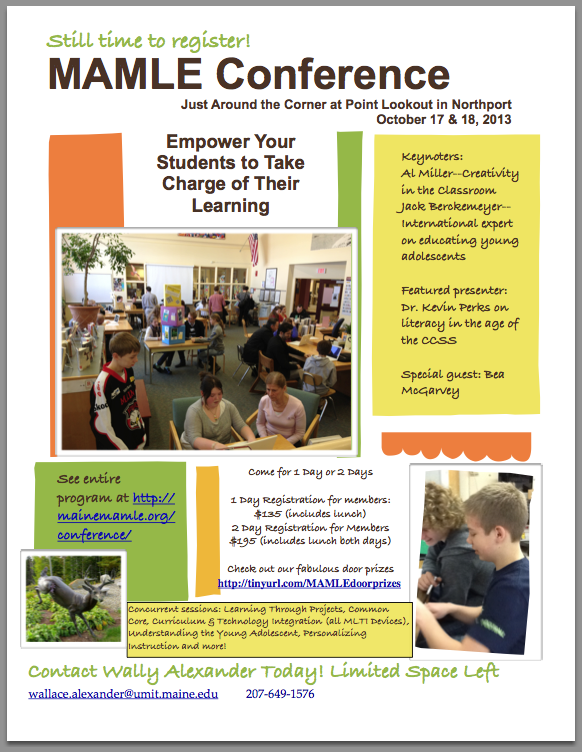
The Annual Conference welcomes with open arms presenters of all ages willing to share successful practices. There are a number of “millennials” presenting at the Annual Conference, October 17-18. You can see the entire program here: http://mainemamle.org/conference/
The Board encourages younger educators to run for the Board and actively recruits colleagues to get involved either as “Ad Hoc” members of the Board or as contributors to our publications. Do you have a particular interest you would like to help MAMLE pursue? Talk to any Board member at the conference, leave a comment below, or contact our Executive Director, Wally Alexander at wallace_alexander@umit.maine.edu
A third point that Sladek makes is that now more than ever, people want a return for any financial investment they make. Obviously, a small, volunteer organization like MAMLE is not going to be offering its members glitzy trips to ritzy resorts or free medical insurance. However, long time members have no trouble describing what they see as valuable benefits for belonging to MAMLE. They share their thoughts in the video below.
Are you in middle level education for the long haul? Is this your life’s work? Are you on a continuous quest to improve your skills as an educator? Do you want to be part of something bigger than your own classroom, team, or school? Do you want to help ensure the state of Maine pays attention to the unique cognitive, social-emotional, and physical needs of our 10-14 year olds? If yes, please join us today!
Undergraduate Student Membership ($5.00)
1st Year Teacher/1st Year Member ($15.00)
Individual Membership ($20.00)
Institutional Membership ($95.00)
International Membership ($30.00)
International Institutional ($120.00)
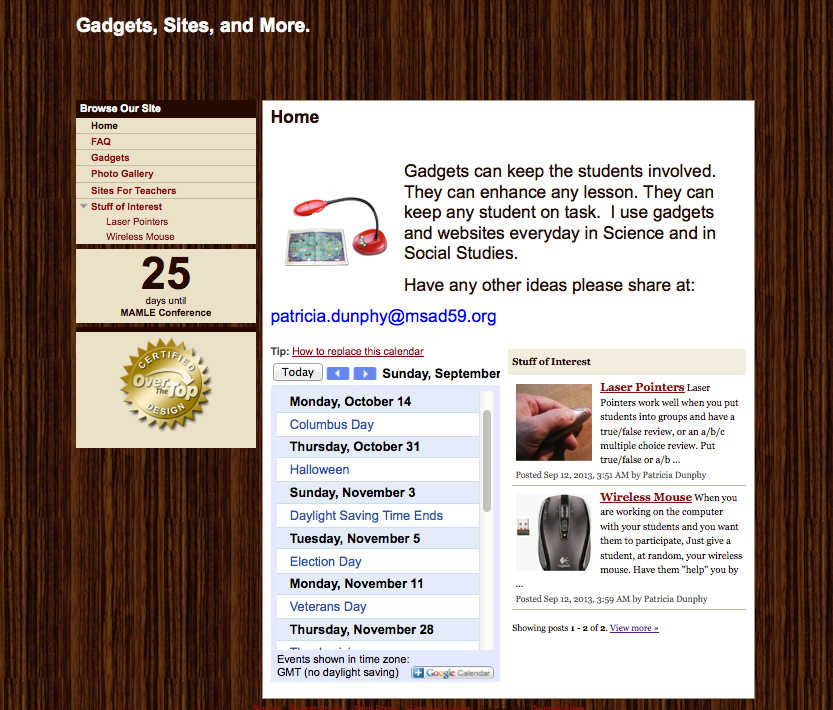
Pat Dunphy from MSAD 59 in Madison shares her Google site below. Click, read, and learn how to use your wireless mouse and laser pointer to actively involve your students in a lesson. Pat will be presenting at the MAMLE Conference on Thursday, October 17–Attend her session to pick up some new strategies!
Education for the 21st Century – Patricia Dunphy, MSAD #59
In this day and age of budget cuts, and world event happening faster than textbooks can be printed; how do we get students the information they need to know to be successful? A laptop, a projector, a pointer, and a Ladibug just might hold the answer. Come explore the ways information and learning can be shared in any classroom, and don’t be afraid to “click”! PENOBSCOT (EDUCATION CENTER)
LiveBinders allows students to organize their digital resources in one place on the web and share the URL with those they are working with and their teacher. Because it is web-based, students can access it from any digital device connected to the Internet at any time. Also students can upload images and notes.
Below is tutorial that explains how to set up an account, put a LiveBinder tool in your bookmark bar, and save and organize resources.
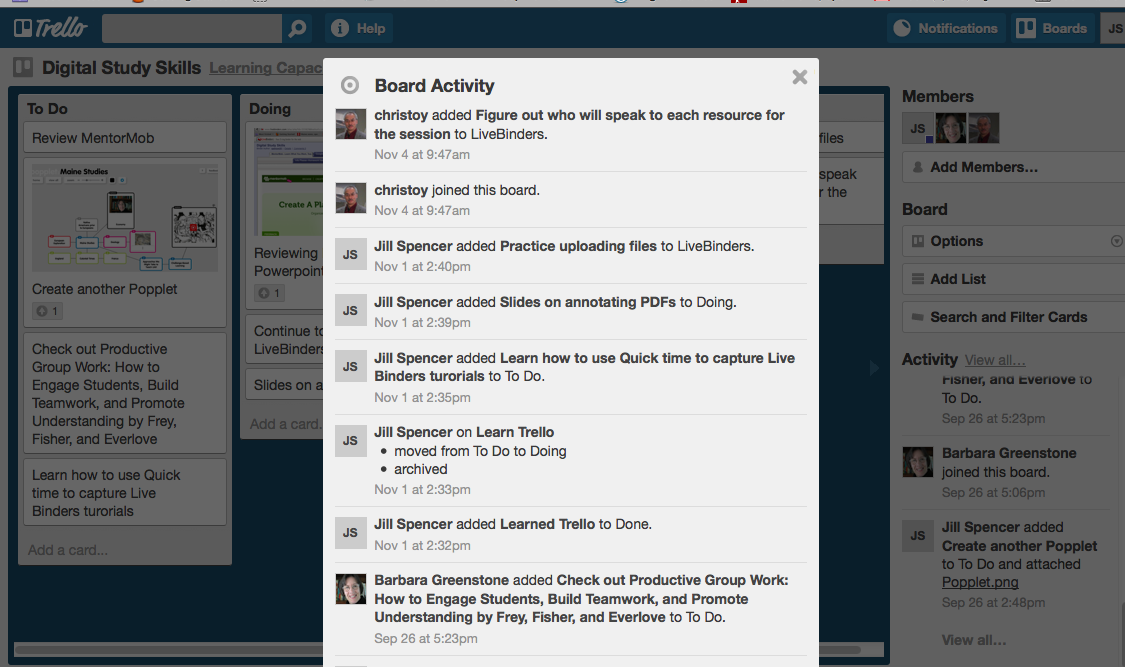
Trello allows students to break their projects down into a series of tasks and then keep track of their progress. As you can see there is a To Do list as well Doing and Done Lists.
The other neat thing about Trello is that the teacher can track who is contributing to the project.
Watch this video to see how Trello works and how it can help your students stay organized and develop self-accountability. The video is from the world of business, however the ideas are easily adapted to the classroom.
There other videos on YouTube about Trello.
What Web 2.0 tools do you and your students find helpful in project work?
The use of iPads, a new teaching and learning device for many, has exploded this year. Check out these 5 sites for ideas and tips for integrating them seamlessly into your classroom:
Tony Vincent’s Videos on YouTube He has been a keynote speaker at ACTEM and other major conferences. His website Learning in Hand focuses on hand-held devices in the classroom. A couple of his videos you probably want to view are…
Chris Toy’s Workshop Materials page Chris travels the world working with educators to effectively integrate technology. Fortunately for those not attending his sessions, he posts his materials on his website. Take a gander to find out about…
In his third post in a series on engaged learning, Mike talks about the importance of revision as one crafts a learning task. Mike’s blog, Multiple Pathways, offers his readers insights into learning, 21st century style. He has generously allowed MAMLE to repost this series. Here is the final installment–enjoy. By the way, have you visited the Maine Center for Meaningful Engaged Learning yet?
A great way to get better at Engaging Tasks is to use the criteria for great Engaging Tasks to critique and revise other Tasks. (I’m not sure that I would say that all Tasks are Engaging Tasks! – or, at least, they don’t all start out that way.)
Imagine that you are living during the Great Depression and that your classmates have decided to put together a time capsule for students of the future to use to learn and understand what life was like during the Great Depression.
Lets start by looking at this critically with an eye to the criteria for Engaging Tasks.
Standards-based: Yes.
All 3 pieces – Scenario, Role, & Task: Task, yes: put together a time capsule. Role: sort of: you are someone living during the Great Depression. Compelling scenario, not really: the Task doesn’t really provide much more of a context for doing this than you and your classmates have decided to do it…
In the form of a “story”- no “teacher talk”: Not written like a little story. Reads like a teacher’s assignment. “Imagine that you are…” “your classmates” are teacher talk, and clues that the Task needs to be revised.
HOTS – Apply, Analyze, Evaluate, Create: Could be, depending on how it is framed.
Students: authentic or believable: Yes, people do leave time capsules for others to open in the future.
Students: interesting or of significance: Mostly: some would clearly enjoy working on this, but there are others who would not. This could be because the Task doesn’t have all three pieces. Often the compelling scenario helps with this.
So if we were to revise this task, we would likely work on the following:
Make sure the Task has a compelling scenario and a stronger role
Rewrite it as a story, and remove the teacher talk
Make sure the Higher Order Thinking focus is more clearly articulated in the activity the students need to complete
Double check that the new version would seem significant and interesting to students (or at least more so than the current version)
A new version of the Task might look like this:
It is 1936 and as part of the New Deal, your town is building a new Town Hall. The mayor has issued a challenge to all the school children to help create a time capsule that will be put in the corner stone of the Town Hall then opened far in the future. Your teacher has broken your class into teams of 4 and 5 students and each team needs to help identify the best items to include in the time capsule. The best ideas will be included in the actual time capsule.
How does this version of the Task fare against the criteria? I’ll let you decide, but here are a couple of my thoughts. I’m hesitant to write tasks where the student is a student (I tend to find more engaging the ones where students can imagine themselves in a different role), but this Task already had them as students; whereas I didn’t mind revising this Task, I didn’t want to totally rewrite it. There is now a compelling scenario (new Town Hall and the Mayor’s challenge). The whole thing is written as a story (ok, there is a little teacher talk here, but not the author telling the reader, rather the teacher is a character in this story – see my comments above about students in the role of students…). And “Which is best?” is a short-cut question for getting to higher order thinking (analysis and evaluation).
How might you now get practice getting better with Engaging Tasks through revision?
Maybe you and a group of colleagues are working to write your own Engaging Tasks. You could swap drafts and critique each other’s, offering suggestions for revisions.






 We have moved!